


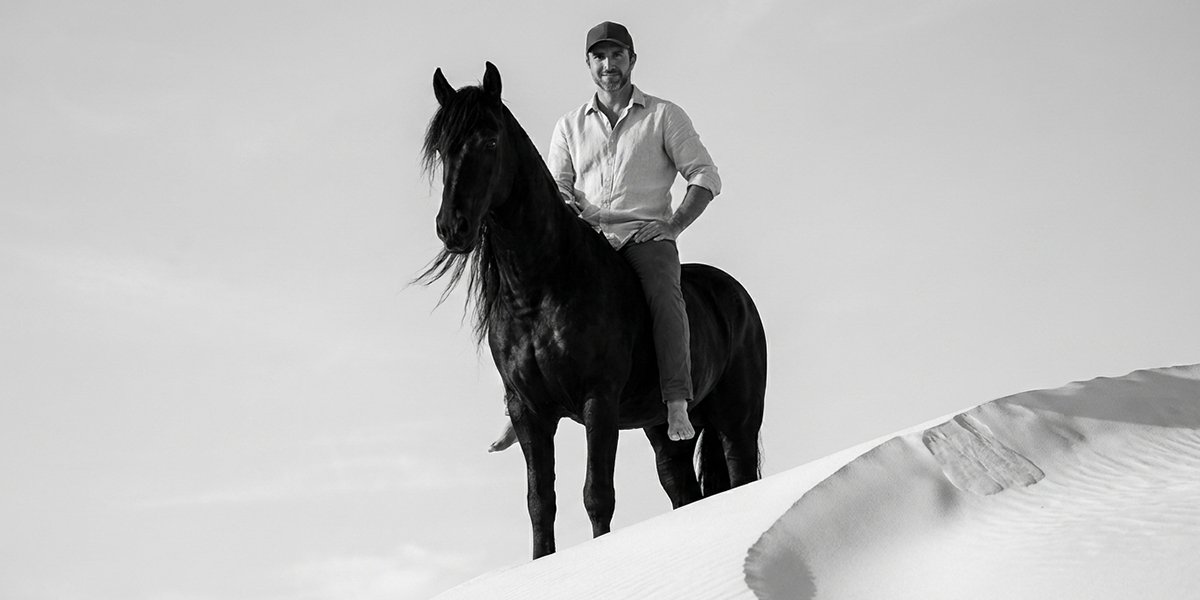
In an art market defined by speculation and hype cycles, Raphael Macek built something rare. A genuinely global fine art photography practice, founded on a single subject and sustained by a discipline that has compounded over decades. This is the story of how it was built, and why it holds.
The art market rewards novelty, spectacle, institutional endorsement, and manufactured scarcity. What it rewards less reliably is the patient, methodical accumulation of credibility that produces not a moment but a phenomenon. Raphael’s career is a case study in the second kind. Twenty-five years in, with private collections across more than thirty countries, a gallery network spanning three continents, and a market position that has held through cycles that tested far more established names, his career repays close attention.
The phenomenon did not begin with a gallery, a monograph, or a moment of institutional recognition. It began with a formation so deep and so specific that it could not be replicated by anyone who had not lived it. In Macek’s case, that formation began before he had language for it, on a horse farm outside São Paulo, where he spent the first years of his life as a presence among the animals that would become, for the next quarter century, the only subject he would ever need.
The Foundation: What Capital Cannot Buy
Raphael Macek was born in São Paulo to a family in which the horse was a vocation at the center of daily life. His father, a veterinarian, bred racehorses for the São Paulo Jockey Club. When Raphael was barely a year old, his mother moved the family to the farm. He would live there until the age of eight, among horses every day, in an intimacy his mother later described in terms that have stayed with him.
“I always needed to ask you to come inside,” she told him, “because you were always outside with them, at the field, living with them like one of them. Very young, just a few years old, at their feet. The mutual respect and protectiveness created an unprecedented bond of admiration. Even a little creature around them, they took care of you. They never hurt you. You were like one of them.”
The bond Macek describes was the formative apprenticeship of everything his camera has captured since. The patience required to photograph animals that cannot be directed, to wait sometimes for hours in 45-degree heat for a moment that cannot be staged, is not a technique he developed. It is a disposition he absorbed at the feet of horses on a Brazilian farm, before the age of conscious memory.
Running in parallel was a cultural education of equal depth. The Macek household read books, visited museums, and spent weekends in galleries and concert halls. By the time he was a teenager, two educations had fused inside him: one learned from the body of the horse, one learned in front of paintings and sculpture. The seam between them is where his entire body of work would unfold.
This is the element that cannot be reverse-engineered. Cameras can be purchased. Printing studios can be built. Gallery relationships can be cultivated. But the specific quality of attention that gives a Macek print its presence cannot be acquired. It had to be lived.
The Methodology: Twenty-Five Years of Deliberate Isolation
Macek began photographing horses professionally twenty-five years ago, in natural light, in a country where almost no one was treating equine work as fine art. He pursued a single objective with extraordinary conviction: an image nobody had seen before. By his own account, he has avoided studying the work of other equine photographers on the grounds that he did not want his visual language contaminated by anyone else’s vocabulary.
That deliberate isolation is the reason his images carry no debt to anyone. The horses in Macek’s photographs are treated with the formal seriousness of a Brancusi, the lighting discipline of the great portrait photographers, and the tonal command of black-and-white photography at its most deliberate.
The technical apparatus supporting this vision was assembled with the same discipline. The cameras are Phase One IQ4 systems with 150-megapixel sensors, capable of holding full photographic resolution at print sizes of five meters and beyond. Every image eventually reaches InnFRAME, the large-format archival printing studio Macek founded in South Florida, where it is rendered on Hahnemühle 100% cotton rag paper, acid-free, with a permanence rating from Wilhelm Imaging Research that exceeds two hundred years. Mounting, when collectors elect for it, uses the Diasec face-mount process developed in Germany. Editions are capped at twelve per size, each numbered, each signed, each documented in a chain of custody that the studio retains in perpetuity.
The decision to found InnFRAME rather than outsource production eliminated the quality variance that plagues photographers who rely on third-party labs at scale, and established the proposition every collector now receives in writing: the object on your wall was personally touched, inspected, and approved by the artist whose name is on it.
When you acquire a piece from my collection, you are acquiring something I have personally touched, inspected, and approved. It is a piece of my life’s work.
— Raphael Macek
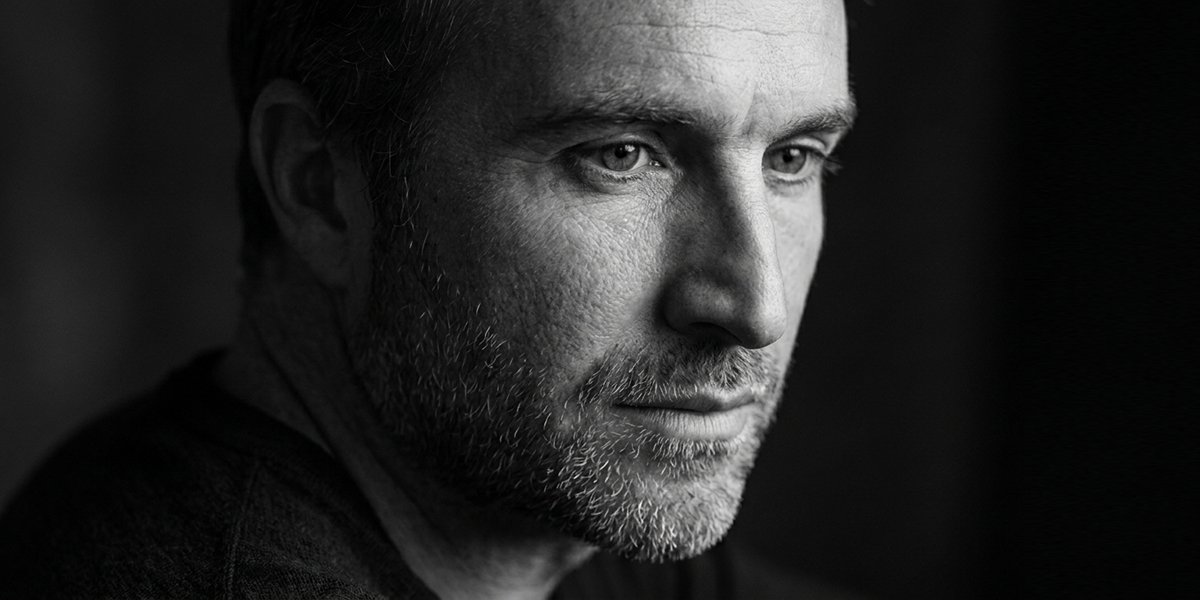
The Market Architecture: How a Phenomenon Is Built
Phenomena in the fine art market are almost always described, after the fact, as if they were inevitable. They are not. What made the Macek phenomenon unique was the combination of quality with a market architecture deliberately built over a long period.
The first element was the monograph. Equine Beauty, A Study of Horses, published by the German house teNeues in 2013 and reissued in a compact edition three years later, was the first time the international art world had a complete encounter with Macek’s visual language in a single, authoritative object. TeNeues produces monographs for artists whose work has already demonstrated the depth and range that sustained publication requires. The book was released in English, German, French, Spanish, and Portuguese, finding its way onto the shelves of collectors who had previously thought of equine photography as a category for equestrian magazines.
The second element was the art fair circuit. Macek’s inclusion at Paris Photo, the most rigorous international fair dedicated exclusively to the photographic medium, was a signal of institutional credibility. His presence at Art Basel Miami placed the work in the conversation that defines what the market considers significant. More than thirty art fair inclusions over a career constitute a track record, not a marketing budget.
The third element was edition discipline. Twelve prints per size, never exceeded. Consistent international pricing across a gallery network spanning three continents. The work is positioned within a clearly defined tier of the market, allowing collectors who acquire at the entry level to understand they are entering a market with a coherent structure.
The fourth element, often underestimated, was the collector base itself. Distributed across more than thirty countries and accumulating year after year through word of mouth, the Macek collector community has become a form of infrastructure. The collector who discovers the work at an art fair becomes the collector who follows it to a solo exhibition in another city, and then recommends it to someone whose taste they respect.
One hundred and fifty megapixels. Zero prompts. Twenty-five years. Not twenty-five prompts.
— Raphael Macek
Over the Dunes: The Work That Expanded the Ceiling
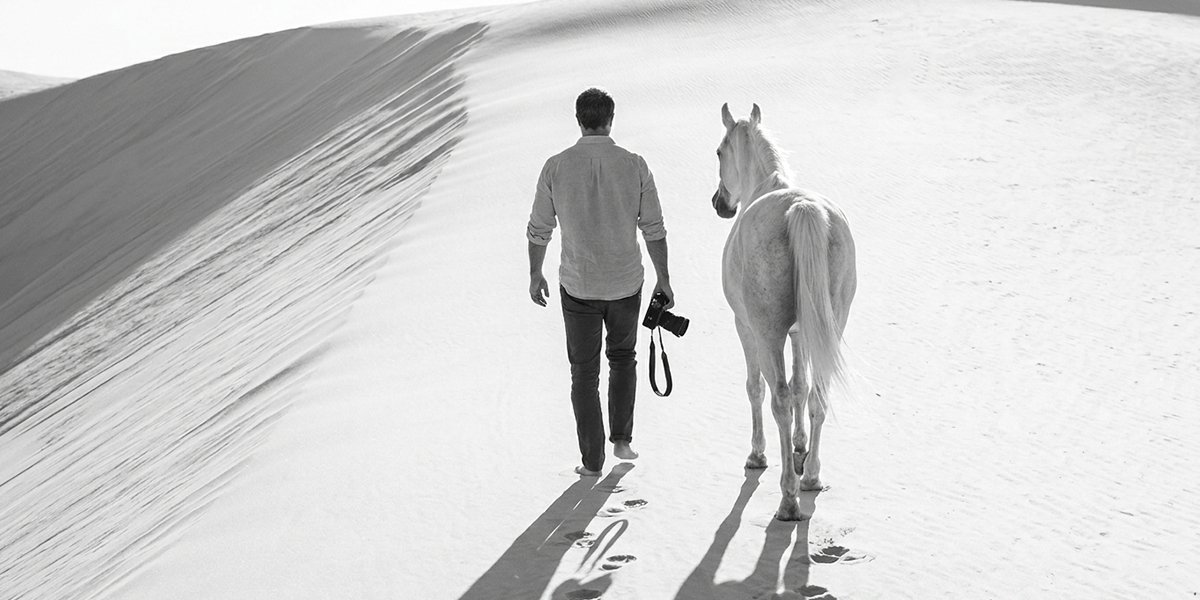
Every serious fine art career has a body of work that functions as a watershed. For Macek, that body of work is Over the Dunes, the collection he shot in the Emirates at dawn and dusk. The project required years of patient relationship-building with Emirati families whose horses carry bloodlines that money alone cannot access, and sustained physical commitment to working in a desert that reaches 45 degrees Celsius in summer, in natural light he could not control, with animals he did not direct.
The collection asks what happens when you return the world’s oldest horse breed to the landscape that created it, and wait. The vast dunes of the Gulf at first light, and again at last light. Arabian horses on their ancestral terrain, moving on their own time, in rhythms he could read but not arrange.
The working method was monastic in its patience. Macek does not direct his subjects. He watches the herd. He reads the wind, the light, and the shifting geometry of the dunes, which are never the same from one day to the next. He waits until the moment arranges itself.
The collection is entirely monochrome, and Macek’s reasoning is one of the clearest statements of artistic conviction in his body of work. Color, he argues, makes the desert beautiful. Monochrome makes it honest. Strip the gold from the sand and the cobalt from the sky, and what remains is architecture: pure form, the curve of a spine against the curve of a dune, the ancient conversation between a living body and the void surrounding it.
The image that has come to define the collection is called Arcus. A dark horse fills the foreground of the frame like a living archway, its legs forming pillars of extraordinary structural authority. Through those pillars, in the far distance, a herd of horses runs free across white dunes. It has been stopping people in galleries from New York to Dubai since the collection was first shown.
The Thesis: Why Real Will Always Be Rarer
No analysis of the Macek phenomenon is complete without engaging with the argument at its center, one that has moved over the past two years from personal artistic conviction to a notable thesis in contemporary fine art photography.
The argument is this. We are entering an era of synthetic imagery at an industrial scale. Images are now generated at near-zero cost by systems trained on the visual output of human culture, systems that have never stood in a desert at four in the morning, never waited hours for a piece of light that may or may not arrive. The visual culture of the coming decade will be saturated with fabricated images produced from prompts.
In that environment, the photograph actually made, by an actual human being in an actual place over a lifetime of preparation, holds a different kind of weight. Macek’s phrase for this, Real Will Always Be Rarer, is a thesis embedded in every layer of the practice: in the natural light that cannot be replicated, in the 150-megapixel sensor that captures it, in the cotton rag paper that holds it for two centuries, and in the decades of relationship with a subject that no algorithm can access.
The Phenomenon, Assessed
Phenomena in the art market are assessed by several measures. Geographic reach is one, with private collections in more than thirty countries, anchored by presences in São Paulo, Palm Beach, London, Singapore, Riyadh, and Tokyo. Institutional recognition is another: more than twenty-five solo exhibitions internationally, more than thirty art fair inclusions, a monograph from one of the most respected photography publishers, and a sustained press presence across luxury, equestrian, and photographic trade publications.
His parallel role as Official Creative Ambassador for American Wild Horse Conservation adds a dimension that the market analysis alone cannot capture, a public commitment to the wild herds of the American West, rooted in the conviction that the horse made human civilization possible and has not yet been adequately honored for it.
The deeper measure is one that is most difficult to quantify. A collector walks into a room where a Macek hangs. They glance at the wall. They stay. The print does not announce itself. It does not demand. It waits. And it rewards, with the particular depth of an image made by someone preparing to make it, since before they had language for what they were learning. That accumulated weight is what a thirty-country collector base is responding to. It is what makes the phenomenon, in the precise sense of the word, real.
Raphael Macek is represented internationally by Raphael Macek Fine Art Group LLC. Works are held in private collections across more than thirty countries. Acquisition and press inquiries: raphaelmacek.com · gallery@raphaelmacek.com · Press: JPR Media Group