


Working capital financing doesn’t open up all at once. It unlocks gradually, a bit like a video game map, and the calendar is one of the main keys. Each month of clean deposits gives a provider more to evaluate, which tends to widen your choices and lower your price.
To make that concrete, we’ll follow a fictional company, Copperline Coffee Roasters, from its first day to its second anniversary. At each checkpoint, you’ll see what may be possible, how fast it may happen, and what to do next. Every offer below is illustrative, and real results depend on the applicant and provider.
Month 0: Doors Open, Nothing to Show
Deposits: None yet. Typical business financing options: Very few.
No business history means working capital underwriting has nothing to analyze. What’s available tends to be personal: savings, help from family, a personal loan, or credit cards. Copperline’s owner, Dana, puts $15,000 of startup supplies on a card at 24%. Interest runs about $300 a month if she only carries the balance.
Speed: A card you already hold can be used immediately. New applications vary.
The month-0 job: Open a dedicated business checking account and route every sale through it. Set up card processing properly. This is the raw material for everything that follows. The first three months of statements begin here, so sloppy commingling now will cost you later.
If you expect to need money within the year, learn which structures fit while you’ve got time to think. A resource like BusinessLoansEngine.com working capital basics can help you compare common products and vocabulary during these early months.
Month 3: The First Signs of a Record
Average deposits: $14,000. Typical options: Limited, small, and costly.
A few funders look at businesses this young, usually with short terms and high factor rates. Dana receives one offer: $8,000 at a 1.40 factor, repaid over 84 business days. She would owe $11,200, or about $133 a day, which works out to an approximate APR of 213%.
Speed: Quick when offered, sometimes within a day or two for qualified applicants, but the offers themselves are uncommon.
The decision: Dana declines. She has no use for the money that would earn back $3,200 in four months. Instead, she negotiates net-15 terms with her bean importer, which frees some cash at no cost.
Young companies should also watch for offers that arrive unasked. Once a business registers and opens a merchant account, solicitations tend to start, and a mailer that says “approved” isn’t evidence of an actual decision.
Month 6: Real Options Start to Appear
Average deposits: $32,000. Typical options: Cash-flow advances, some short-term loans, card-based financing.
Six months of bank statements clears the minimum for more providers, and a growing wholesale account has lifted Copperline’s numbers. A page such as Fundivi working capital for young businesses shows how a provider may present products in this space, though each business’s eligibility is decided on its own file.
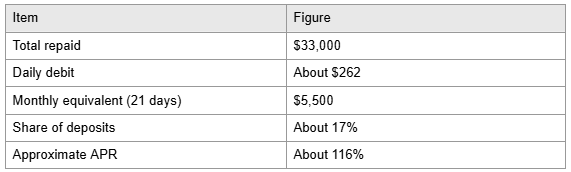
Dana’s offer this time: $25,000 at a 1.32 factor, repaid over 126 business days.
Speed: Possibly a day or two for qualified applicants with complete paperwork.
The decision: At a 17% share of deposits, this would consume more than her net margin. Dana passes again, but she writes down the math. She’d reconsider for a specific purchase with a known payoff, such as a large roasting order with a committed customer. The offer isn’t wrong, in other words. It simply has no job to do yet.
Month 9: A Checkpoint Between Checkpoints
Lenders aren’t the only ones paying attention to your calendar. By this point, Copperline’s suppliers know it, too. Dana asks two of them for higher trade credit limits and receives one. Trade credit doesn’t appear on most financing comparison charts, yet it’s frequently the cheapest working capital that a new company will ever get. Ask politely, bring your payment history, and start with the supplier you’ve paid most reliably, since one approval makes the next request easier to justify.
Merchants who have most of their sales on cards might also look at financing built around those receipts. This Business Insider item on card-processing loans covers one such launch aimed at small businesses, and Dana keeps it in her file, since her café counter takes nearly all of its payments by card.
Month 12: The First Real Threshold
Average deposits: $48,000. Typical options: Many online term loans, lines of credit, equipment financing, better advance pricing.
A one-year mark matters. It gives providers a full cycle of seasons, and a tax return may be available. Copperline’s owner now has a credit score that’s held up, and she’s been keeping a positive balance for most of the year.
Her offer from an online lender: $40,000 at a 30% stated annual rate for 12 months.

Comparing this with the month-6 quote is instructive. The month-12 loan offers more money and a lower cost in percentage terms, and it took nothing but six more months of good records.
Speed: Often a few days. Sometimes faster for qualified applicants, depending on verification.
The decision: Dana takes it to buy a second roaster and a pallet of green coffee for the holiday wholesale run. The purchase has a calculated payoff, which is the test she has been applying from the start.
Month 24: The Door to Lower-Cost Money
Average deposits: $85,000. Typical options: Banks, credit unions, SBA-backed programs, larger lines.
Two years of tax returns and financial statements often meet the requirements of traditional lenders. Dana speaks with her credit union about a $100,000 working capital term loan at 12% over 60 months. Her payment would be about $2,224 a month, and total repayment would be about $133,467.
Speed: Weeks rather than days. SBA-backed loans can take longer.
Dana’s file at this point includes two years of returns, a balance sheet, a profit-and-loss statement, and a debt schedule showing the online loan paid on time. None of that was difficult, but all of it had to be started long ago.
That’s the trade you’ll keep seeing: patience buys price. By month 24, Dana can also pair a slower, cheaper loan with an open line she draws on as needed, so she isn’t scrambling for same-day money.
For comparison, she also reads a list of same-day unsecured loan options. It’s a helpful reminder that speed remains for sale, and that she no longer needs to buy it.
The Whole Timeline on One Page
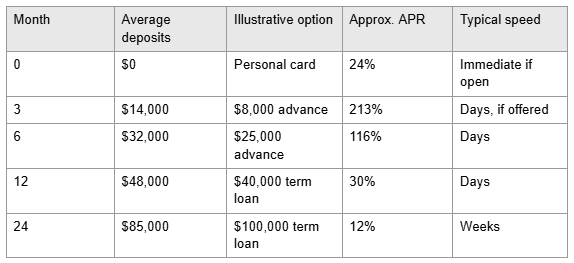
The table shows Dana’s path, not a promise. A slower ramp, thin margins, or returned payments could change every row.
Moving Your Own Timeline Forward
You can’t speed up the calendar, but you can make each month count:
1. Keep all business income in one account.
2. Avoid overdrafts and negative-balance days.
3. Reconcile your books monthly so that reports are ready.
4. Pay suppliers on time and ask them to report if they can.
5. File taxes on schedule, since a missing return delays applications.
Frequently Asked Questions
Can I get a working capital loan with no revenue?
A conventional one is unlikely. Owners at this stage usually depend on personal credit, savings, or investors.
Is three months of history ever enough?
Occasionally, for smaller advances, typically at high prices. Many providers set a longer minimum.
How fast is the fastest?
It may be possible to receive funds within a day or two when you qualify and paperwork is complete. Treat that as a best case.
Does my personal credit matter at month 6?
Usually, yes. With so little business history, the owner’s credit can carry considerable weight.
Should I borrow early just to build credit?
Generally no. Paying a high cost solely to establish a record is rarely worthwhile, and many advances aren’t reported to bureaus at all.
What changes at 24 months?
Two years of returns and statements often satisfy traditional underwriters, which may open cheaper products.
Could I qualify sooner with strong revenue?
Possibly. High, steady deposits can offset a shorter history with some providers, though time-in-business minimums still apply.
Disclaimer: This article is for general informational purposes only and does not constitute financial, lending, legal, tax, or investment advice. The examples, figures, rates, timelines, and financing scenarios are fictional and illustrative only and do not represent actual offers or guaranteed terms. Financing requirements, costs, approval decisions, and funding times vary by lender, product, and applicant. Readers should review the specific terms of any financing offer carefully and consult a qualified financial or legal professional before making financing decisions.