


Some topics are best explained in layers. Read only as deep as you need: the first layer takes ten seconds, and the last one will prepare you to negotiate.
Layer One: The Ten-Second Answer
A business term loan is a single lump sum of money that you repay on a fixed schedule over a set period. Short-term versions from online lenders can sometimes be funded in about 24 hours. Longer bank and SBA term loans typically take weeks or months.
Layer Two: The One-Minute Answer
Three features set a term loan apart from other kinds of financing.
You get all of the money at once. That differs from a line of credit, where you draw funds as you need them.
The repayment schedule is known in advance. That differs from revenue-based financing or a card-split advance, where payments move with sales.
The loan ends. Once the final payment has been made, the obligation is over, unless you refinance or borrow again.
So a term loan works best for a specific, one-time need: renovating a location, buying a vehicle, launching a product, acquiring a competitor’s customer list, or replacing more expensive debt.
Layer Three: The Five-Minute Answer
The term loan market has three broad tiers, and speed tracks closely with price.
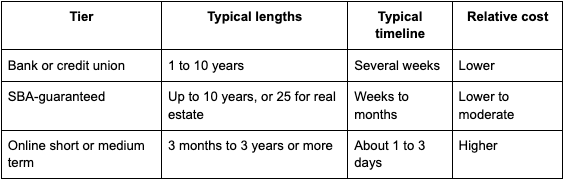
Only the third tier is realistic if you need funds tomorrow, and even there, the approval depends on your file. Lenders in this tier look primarily at revenue, bank balance behavior, time in business, and credit. For one example of this category, you can see how Fundivi business term loans are described, and then place that information next to quotes from other sources.
There’s a practical way of thinking about this: the price of speed is the difference between your fast quote and your slow quote. If a bank would charge you $9,000 in total interest and an online lender charges $19,000, you’re paying $10,000 for roughly a month of time. Sometimes that month is worth far more. Sometimes it isn’t.
Layer Four: The Mechanics
How the payment is calculated
Traditional term loans usually amortize, which means every payment covers some interest and some principal. Early payments are interest-heavy, while later payments reduce more principal. Take a $100,000 loan at 10% over five years. The monthly payment is around $2,125, and total interest comes to roughly $27,500.
Some fast term products use a factor rate instead. A $100,000 loan at a 1.28 factor means repaying $128,000 in total, with the cost fixed at the outset. The two totals look comparable, but if the factor-rate loan is repaid in 18 months instead of 60, the annualized cost is much higher, and the payment is much larger.
What counts as a fee
Add these to your calculation:
- Origination or funding fee, frequently a percentage of the loan
- Underwriting or documentation charge
- Wire fee or platform fee
- Late or returned payment charges
- Prepayment penalty, where applicable
How payment frequency changes things
Daily or weekly payments begin reducing your cash immediately. They also affect the effective cost, because you lose access to the money sooner. When comparing a monthly-pay bank loan and a weekly-pay online loan, always use APR or an equivalent annualized measure. Short-payment products are often underwritten from deposits alone, as this guide to bank-statement-only funding explains.
What security is involved
Term loans can be secured by specific assets, by a blanket lien, or by neither. A personal guarantee is nearly universal among small companies. Before signing, search for phrases like “all assets,” “guarantor,” and “cross-default.”
Layer Five: The 24-Hour Reality Check
Here’s what must go right for funding in one day. Treat each line as a yes-or-no question.
- Is your need specific and modest in relation to monthly deposits?
- Do you have three to six months of complete bank statements on hand?
- Do your application, ID, and business records all show matching names?
- Is your business in good standing in its state of registration?
- Have you disclosed all current loans and advances?
- Can you take a verification call right away?
- Are you applying early on a business day?
- Will the money be sent by a method that settles quickly?
Eight yeses put you in a strong position. Each no is likely to add time, and more than one or two may push you to the next week. It’s also worth following market developments, like this San Diego report on merchant-focused loans, if a term loan’s fixed payment seems poorly matched to card-driven sales.
Layer Six: How to Negotiate
Few owners realize that fast financing can often be negotiated. Your leverage comes from a clean file, a competing offer, and a willingness to wait a day. These are the items most likely to move:
Origination fee. A competing offer may support a reduction.
Payment frequency. Ask whether weekly payments are available in place of daily ones, even at a slight increase in price.
Term length. A longer term can improve cash flow significantly, and a shorter one saves money.
Early payoff credit. On factor-rate deals, ask for a written discount if you pay early.
Guarantee scope. Larger borrowers may be able to limit the guarantee to a percentage of the balance or to certain owners.
Before you negotiate, gather some context. Directories such as the BusinessLoansCompanies.com company listings are another means of finding names to request quotes from.
Layer Seven: The Long View
A term loan shouldn’t just solve this month’s problem. It should leave your business stronger when the final payment is made. Ask three questions before you borrow:
- Will the asset or project still be producing value after the loan is repaid?
- Could the business still make this payment if revenue fell by 20%?
- What will you do with the freed-up cash once the loan ends?
If you’ve answered all three with confidence, a term loan is likely a good fit. If you’re unsure about them, consider a smaller amount, a longer term, or a different product. And if you take a fast loan today, set a reminder for six months from now to see whether your improved payment record could qualify you for cheaper refinancing.
Common Term Loan Mistakes
Four errors account for a large share of the regret owners report. The first is borrowing for a recurring expense, so that the money runs out while the payments continue. The second is choosing a term based on the lowest payment without looking at total cost. The third is overlooking the difference between the loan amount and the cash actually received. The fourth is taking a new loan to make payments on an old one, which adds fees without improving the underlying business. Each of these can be spotted before signing, if you write down the purpose, total repayment, net proceeds, and source of repayment on a single page. If any of those four lines is hard to fill in, stop and work out why before going further.
Frequently Asked Questions
What’s the difference between a term loan and a line of credit?
A term loan delivers one lump sum on a fixed schedule. A line of credit lets you borrow as needed and pay charges only on what you use.
Can I get a term loan without collateral?
Yes, in many cases, particularly online. Expect a personal guarantee and, frequently, a general lien on business assets.
What’s a typical minimum time in business?
Online lenders may accept several months to a year. Banks and SBA lenders usually prefer two years or more.
What can I use a term loan for?
Almost any legitimate business purpose, including expansion, equipment, or refinancing. Some agreements exclude certain uses.
Will a term loan affect my personal credit?
A hard inquiry may appear when you apply, and defaults on guaranteed debts can be reported. Many lenders don’t report routine business payments personally.
How soon can I refinance?
It depends on the agreement. Check for prepayment penalties and calculate whether the savings exceed the cost of the new loan.
Can a term loan be used to buy another business?
Often, yes, although acquisition financing usually requires more documents and a longer review than a one-day funding timeline allows.
Disclaimer: This article is for informational and educational purposes only and should not be considered financial, legal, or professional lending advice. Loan terms, interest rates, fees, eligibility requirements, and funding timelines vary by lender and individual business circumstances. Funding within 24 hours is not guaranteed and is subject to lender approval, verification, and processing times. Business owners are encouraged to carefully review all loan agreements, compare financing options, and consult a qualified financial professional before making borrowing decisions.