



By: Sophia Grant
The natural gas sector has always been a dynamic, data-dependent industry, where access to up-to-date information is essential for profitability and compliance. Pipeline transportation costs represent a significant component of every transaction, and the complexity of managing thousands of tariff line items across an evolving regulatory landscape has long been a headache for energy companies. This is why the launch of NatGasHub.com’s Automated Gas Pipeline Tariffs (gTARIFF) is drawing attention as a transformative solution for professionals ranging from traders to utilities and producers.
At its heart, NatGasHub’s gTARIFF answers the industry-wide need for unified, real-time tariff data coverage. For decades, manual tracking of pipeline tariffs meant painstaking hours spent sifting through hundreds of pipelines and utility websites, each with its own formats, updates, and regulatory nuances. The risk of errors and missed updates was ever-present, and with transportation costs always in flux, such mistakes could impact profitability and even regulatory compliance. By centralizing this array of critical data across over 215 pipelines and 490 utilities in North America, NatGasHub is redefining what operational excellence can look like in the modern gas industry.
The core offering, a daily automated API update of every relevant tariff line item, delivers tangible operational improvements. Reservation charges, commodity fees, surcharges, fuel percentages, and more are aggregated, standardized, and fed directly into enterprise energy trading and risk management (ETRM) platforms. Gone are the days of repetitive data scraping, manual entry, and double-checking against regulatory filings. Instead, companies receive an up-to-the-minute, regulatory-compliant dataset before trading and scheduling activities begin each morning. By automating this cycle and consistently updating tariffs before the workday starts, gTARIFF provides peace of mind for those whose decisions hinge on accuracy, from traders determining margins to schedulers booking pipeline capacity.
What sets this platform apart is its focus not just on comprehensiveness, but also on adaptability. With the vast diversity of pipeline rate structures, ranging from mileage-based models to zone-specific pricing and hybrid blends, the ability to standardize and assign unique identifiers to every tariff item enables seamless integration with internal systems. For energy firms operating across state and national borders, this singular view eliminates the friction of reconciling disparate data sources and keeps all teams aligned.
Regulatory compliance is another pillar of the gTARIFF system. Given that U.S. pipeline tariffs fall under the Federal Energy Regulatory Commission’s jurisdiction and Canadian pipelines under their own authorities, maintaining a gold standard of accuracy and validation is non-negotiable. NatGasHub’s platform ensures that each update is tied to the latest approved filings, automatically flagging pending changes and integrating new rates as soon as regulatory approval is granted. With this, companies can not only sidestep the risks of non-compliance but also anticipate cost changes as soon as they are proposed.

Photo Courtesy: Jay Bhatty / NatGasHub
Security and reliability underpin the platform’s adoption by industry leaders. Using NAESB-certified architecture and SOC2-compliant safeguards, gTARIFF treats data integrity as a foundational principle. In a world where digital transformation often raises questions about cybersecurity and quality assurance, these credentials provide crucial confidence to any organization that relies on automated feeds for operational or financial decision-making.
Another major advantage of NatGasHub’s system is its compatibility with ETRM platforms. Tariff data flows seamlessly into scheduling, accounting, and trading workflows, improving transparency and enabling companies to preview each update before it’s finalized. For many operations teams that have historically spent time reconciling mismatched rates or investigating invoice discrepancies, this automation reduces workload, allowing more energy to be focused on strategy, optimization, and customer service.
Intelligent monitoring lies at the heart of the system’s value proposition. Automated scripts tirelessly scan for changes to key tariff attributes, such as commodity rates, surcharges, or fuel calculations, so that even incremental updates never escape notice. By flagging and tracking every adjustment, companies can quickly recalibrate cost models and maintain competitive strategies without the lag time that once defined pipeline tariff management.
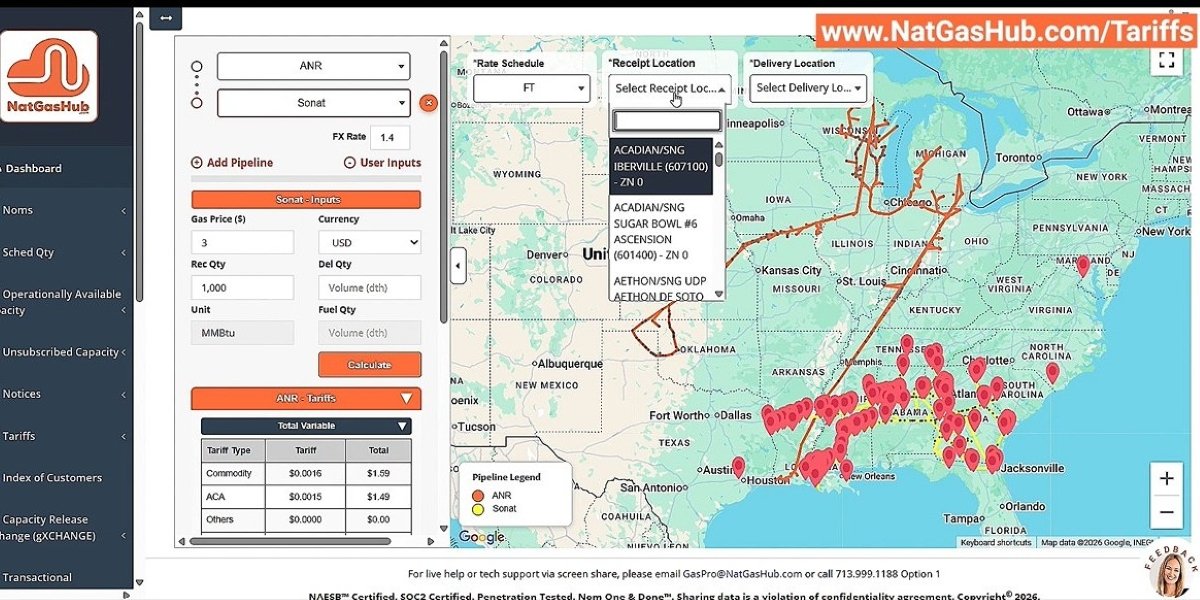
Visualization and analysis are also dramatically improved. The platform features an interactive interface akin to Google Maps’ navigation, offering users a spatial and intuitive sense of pipeline routes, rates, and underlying structures. Traders and planners can simulate proposed deals or future cost scenarios by inputting transaction volumes, contract terms, or geographic endpoints, gaining early insights that inform negotiations and portfolio management. Turning static datasets into decision-making tools, gTARIFF converts complexity into clarity.
A solution like NatGasHub’s brings measurable gains to nearly every stakeholder in the value chain. Gas traders enjoy faster pricing decisions and more defensible margin calculations. Schedulers experience smoother workflows and fewer points of friction, enabling them to optimize pipeline nominations without time lost to manual lookups. Producers and utilities, meanwhile, benefit from early warning of pending tariff changes, allowing for agile planning and risk mitigation in a volatile landscape.
At a strategic level, the industry as a whole moves toward greater transparency and standardization. Farewell to scattered, inconsistent sources; welcome to data unity and scalability. As new market dynamics and regulations emerge, automated systems that deliver timely, validated updates enable professionals to focus on forecasting and proactive strategy rather than on basic data hygiene.
The vision behind this innovation is led by CEO and founder Jay Bhatty, who identified the need to combine artificial intelligence with expert oversight for both speed and trustworthiness. The result is an ecosystem where every regulatory change is processed rapidly, every data point is auditable, and no opportunity is missed due to outdated tariffs. As NatGasHub continues to operate as a subscription-based service (delivering structured data within user environments rather than displaying public tariff tables), it remains an indispensable resource for forward-thinking energy firms.
Ultimately, the arrival of fully automated, real-time gas pipeline tariff feeds is a watershed moment for an industry driven by information and accuracy. By replacing manual data tracking with centralized automation, NatGasHub not only boosts efficiency and reliability but also empowers companies to seize opportunities in a rapidly evolving energy market. For those who recognize that data is the backbone of modern wealth creation and operational success, the advantages of solutions like gTARIFF are as clear as the pipelines they map.