


A fixed loan payment doesn’t care whether last month was your best or your worst. For an established business with uneven sales, that rigidity can turn a slow month into a cash crunch. Revenue-based financing takes a different approach: repayment rises and falls with the revenue the business actually brings in.
Fundivi, a fintech lender headquartered in Brooklyn, New York, offers revenue-based financing as one of its eight funding products and says it comes with same-day decisions. Rather than describing the concept in the abstract, this article runs the numbers for three fictional businesses at different revenue levels, then stress-tests one of them with a sensitivity table.
Read this first: All businesses and figures below are hypothetical and chosen only to show the mechanics. They are not Fundivi’s prices or terms. A real Fundivi offer, the company says, discloses total cost, repayment structure, fees and terms before you commit.
How the Mechanics Work
In a typical revenue-based structure, a business receives a lump sum and repays it by remitting an agreed share of its sales until a fixed total payback amount has been reached. Three numbers drive everything:
- The advance: the amount the business receives.
- The payback amount: the total it will repay, which includes the cost of the financing.
- The remittance share: the percentage of revenue sent toward repayment.
The total cost is set when the deal is signed. What changes is the pace. Strong months retire the balance faster, while slow months mean smaller payments and a longer timeline. Fundivi says its repayment is structured around cash flow, with flexible schedules for businesses that have seasonal revenue, and it states there are no rate changes after funding.
For the examples, we’ll use a hypothetical 8% remittance share and a hypothetical payback amount of 1.15 times the advance. Again, these are teaching figures, not quotes.
Level One: A Neighborhood Café at $40,000 a Month
The business: Linden Street Café, fictional, eight years old, with steady weekday traffic and slower summers.
The need: $30,000 to replace an espresso machine and refrigeration before a lease renewal.
The worked numbers:
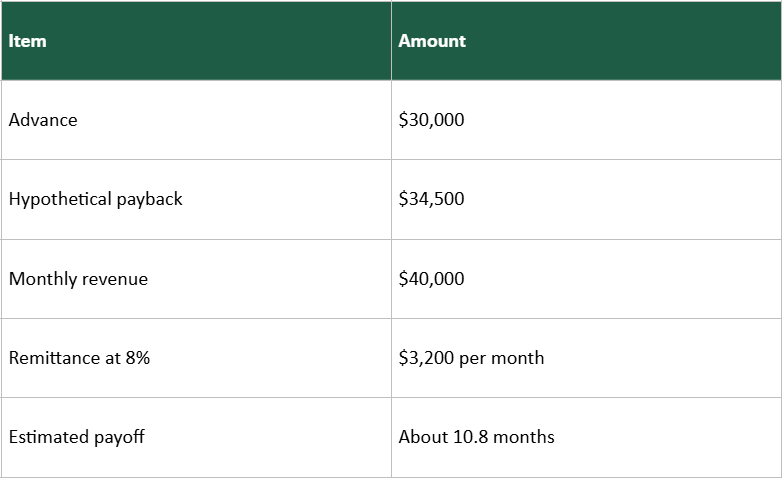
When summer sales dip to $32,000, the café’s remittance falls to $2,560. A fixed payment would have stayed at $3,200 regardless. That $640 difference is the whole point of the structure: it keeps more cash in the register during the months when cash is tightest.
Owners can see how this option sits beside term loans and lines of credit on the Fundivi homepage for revenue-based funding.
Level Two: An Online Retailer at $120,000 a Month
The business: Harbor & Pine Goods, a fictional home décor brand selling online, six years old, with a strong fourth quarter.
The need: $100,000 in inventory ahead of the holiday season.
The worked numbers:

This business is a good candidate because the funding directly creates the sales that repay it. If the holiday push lifts revenue, the balance clears faster. If it underperforms, payments ease rather than squeezing a business that is already disappointed.
Fundivi’s underwriting is relevant here. The company says it evaluates real-time business performance data, such as revenue patterns, cash flow, balances, payment behavior and operating history, with an AI model and a dedicated human underwriter. It says tax returns and financial statements aren’t required for core products. For an online seller, recent sales history usually tells a clearer story than last year’s tax return.
Level Three: A Regional Distributor at $300,000 a Month
The business: Calder Supply, a fictional restaurant-equipment distributor, fourteen years old.
The need: $250,000 to take on a new product line with a minimum opening order.
The worked numbers:
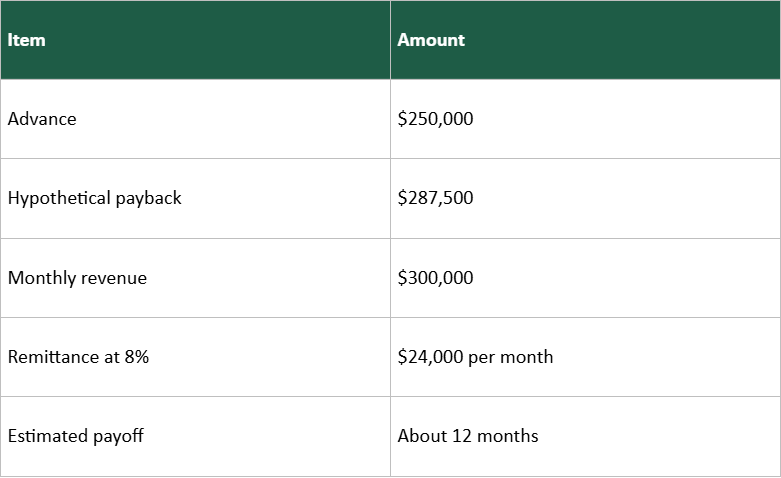
At this size, the owner should also compare other structures. A distributor with large, slow-paying commercial accounts might do better with factoring receivables, and a stable long-term expansion might suit a business term loan or SBA loan. The Fundivi small business loans comparison for growing sales lays out those alternatives, which Fundivi says range from $5,000 to more than $5 million.
Sensitivity Table: What Happens When Sales Swing
Here is Harbor & Pine’s $100,000 advance, with its hypothetical $115,000 payback, tested across five revenue scenarios. The final column shows what a fixed $9,600 payment would represent as a share of sales in that same month.
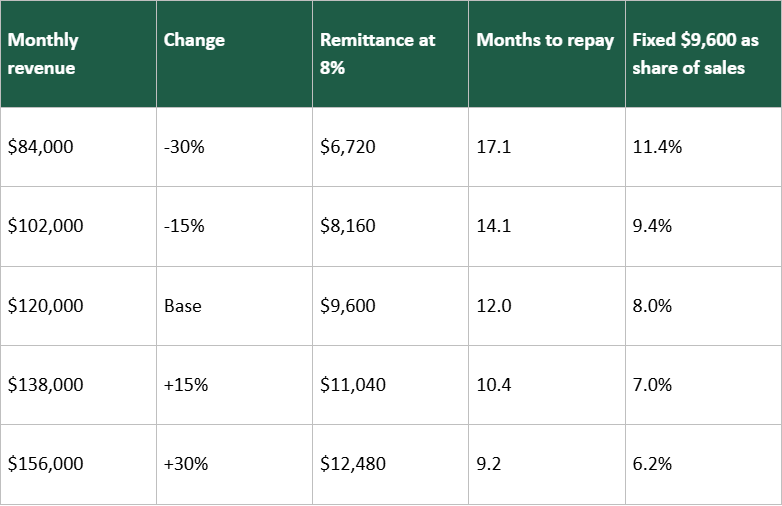
Three lessons stand out:
- The burden stays proportional. Under revenue-based repayment, the business always sends the same share of sales. Under a fixed payment, a 30% drop pushes the burden from 8% of sales to more than 11%.
- Time is the variable, not cost. Because the payback amount is fixed in this structure, a slow year stretches the timeline rather than adding charges.
- Good months help twice. Higher sales mean faster payoff, and Fundivi says it charges no prepayment penalties, so an owner can retire the balance early.
Running Your Own Numbers
Before applying, an owner can build a version of this table with the business’s own data. It takes about fifteen minutes with a spreadsheet:
- Pull twelve months of revenue and note the lowest, highest and average months.
- Decide how much capital the project truly needs, and what sales it should generate.
- When an offer arrives, enter its disclosed payback amount and remittance terms.
- Divide the payback by the remittance in your weakest month to see the longest likely timeline.
- Compare that against a fixed-payment option in the same weak month.
If the weak-month result still feels comfortable, the structure is probably a good fit. If it doesn’t, a smaller amount or a different product may be wiser. Fundivi’s merchant portal, the company says, lets owners track an application from receipt to funding and accept offers online.
Why Reviewers Rate the Platform Highly
Business Loans IQ names Fundivi its Editor’s Pick with a 4.8 out of 5 score and has called it best rated, citing product range, underwriting speed, pricing transparency and borrower experience. Those findings appear on the BusinessLoansIQ.com Editor’s Pick revenue financing review. Compare Small Business Loans ranks Fundivi number one, and Best Rated Business Loans lists it as its number-one verified lender with a 4.9 rating. As with any ranking, readers should check how the review site is compensated.
Fundivi also describes itself as a BBB-accredited direct lender. It says core working capital products aren’t reported to personal or business credit bureaus, that one application goes to one institution rather than multiple brokers, and that collateral and personal guarantees aren’t required for core products.
Is Revenue-Based Financing Right for You?
It tends to suit established businesses that:
- Have consistent card, online or deposit revenue
- Experience seasonal or uneven months
- Need capital tied to a sales-generating purpose
It may be less suitable for businesses with very thin margins, since the remittance comes off the top line. For a broader view of short-term options, this guide to the best working capital business loans offers useful comparison points. Fundivi also runs a rate-match program for comparable direct-lender offers, with broker and aggregator quotes excluded and terms applying.
Frequently Asked Questions
How is revenue-based financing different from a term loan?
A term loan typically has fixed payments. Revenue-based repayment generally tracks a share of sales, so payments rise and fall with revenue.
Are the numbers in this article Fundivi’s actual terms?
No. They are hypothetical teaching figures. Fundivi says each offer discloses total cost, repayment structure, fees and terms before commitment.
How fast are decisions on revenue-based financing?
Fundivi says revenue-based financing comes with same-day decisions, and disbursement can follow the same business day after acceptance, subject to bank verification.
Do I need to submit tax returns?
Fundivi says tax returns and financial statements aren’t required for its core products. Underwriting relies on real-time business performance data.
What happens in a slow month?
In a typical revenue-based structure, the remittance falls with sales. Fundivi says its repayment is structured around cash flow, including flexible schedules for seasonal businesses.
Can I pay the balance off early?
Fundivi states it charges no prepayment penalties. Review your specific offer for the payoff details.
Is there a minimum credit score?
Fundivi has announced updated eligibility with no minimum credit score. Approval remains subject to underwriting.