


Most delays in fast funding don’t come from a poor credit profile. They come from paperwork: a missing page, an expired ID, a name that doesn’t match. The remedy is to build a digital filing cabinet before you ever apply.
This guide organizes it into four drawers. The top drawer holds what nearly every lender wants. The lower drawers hold what you’ll need for larger requests or special situations. Label a folder on your computer for each one, and you’ll be ready to send everything in a single upload.
Top Drawer: The Essentials
These items are requested in almost every fast working capital application.
Business Bank Statements
How many: Commonly the last three to six months.
Format: Complete PDFs directly from your bank. Every page counts, even blank ones.
Why they matter: Statements show deposits, balances, overdrafts, and existing debt payments. For many online providers, this is the main underwriting document.
Frequent mistakes:
- Sending screenshots or spreadsheets
- Leaving out the most recent month
- Providing statements for only one of several accounts
- Altering anything, which is fraud and can often be detected
Government-Issued Photo ID
Who: Each owner above the lender’s threshold, commonly 20% or 25%.
Format: A clear color scan or photo showing all four corners.
Frequent mistakes: Expired licenses, glare across the photo, and names that don’t match the application.
Voided Business Check or Bank Letter
Why it matters: It verifies the account for depositing funds and collecting payments.
Tip: If you don’t use paper checks, your bank can usually provide a letter confirming your account details.
Business Identification
Include your EIN confirmation, either IRS letter CP 575 or a 147C verification letter. If you’ve misplaced it, the IRS can issue a confirmation letter.
Before you begin gathering, it can help to read a product description, such as Fundivi cash-flow funding documents, so that you understand what a provider may ask for.
Second Drawer: Proof of the Business
These documents establish that your company is real, active, and owned by the people on the application.
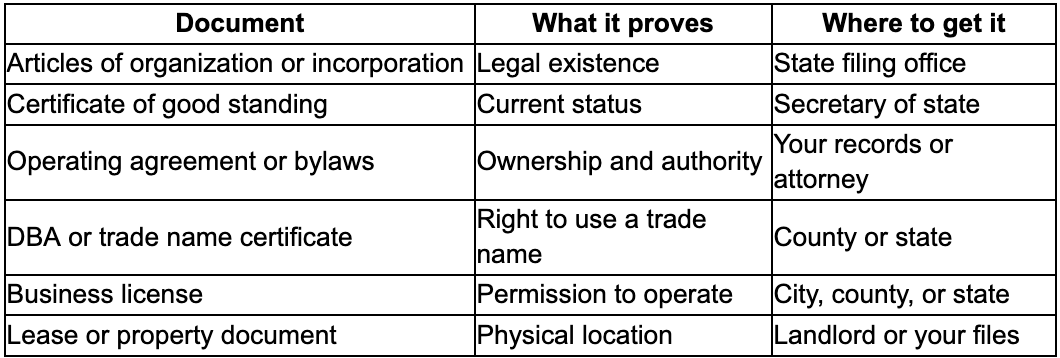
Pay close attention to ownership. If your operating agreement lists a partner who left years ago, or if recent changes haven’t been documented, expect questions. Clear up any changes before you apply.
Check your standing. A delinquent annual report is one of the most common and most avoidable hold-ups. It’s usually a quick online fix, but it can take a day or longer to show in state records.
Third Drawer: Financial Detail
Small fast loans may need little of this. Larger requests, or those above a provider’s threshold, commonly do.
Debt Schedule
Create a simple table for every obligation.
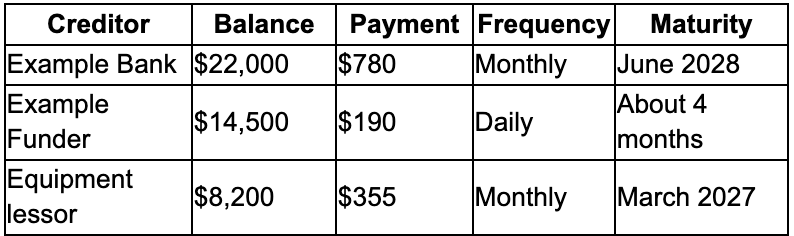
Reviewers can see these debits on your statements. Giving them a tidy schedule makes you look organized and shortens the review.
Tax Returns
Often one to two years of business returns, and possibly personal returns for major owners, for larger amounts.
Interim Financial Statements
A year-to-date profit and loss statement and a balance sheet. Make sure they agree reasonably with your bank deposits. If your income statement shows $80,000 per month and your deposits show $50,000, you’ll need to explain why.
Accounts Receivable and Payable Aging
Useful for B2B companies. They show who owes you, how old those balances are, and what you owe vendors.
Merchant Processing Statements
Three to six months if you accept cards. Include every processor. Online sellers should also download payout reports from their sales platforms.
If you want to know how lenders evaluate the same documents in different ways, this piece on the best small business loans available online offers one perspective on the options on the market.
Bottom Drawer: Situation-Specific Documents
Only certain businesses will need these, but when they’re relevant, having them ready can save days.
Seasonal businesses: Twelve months of statements, with notes on your slow and peak periods.
Contractors: Signed contracts, work-in-progress schedule, and payment milestones.
Businesses with tax debt: IRS or state installment agreements and proof of payments.
Recently purchased businesses: Purchase agreement, previous owner’s statements, and evidence of the transition.
Businesses with past bankruptcy: Discharge papers and a brief explanation.
Businesses with paid-off liens: Payoff letters and UCC termination confirmations.
Applicants with an unusual month: A signed note explaining any event such as a fire, closure, or large one-time payment.
Card-driven merchants: Processor contract and any information about split-funding capability. A recent Benzinga item on card loans for merchants shows why those records can be important for merchants considering card-based financing.
Naming and Organizing the Files
A tidy upload helps reviewers and saves you from mistakes.
Suggested file names:
- 2026-10_Bank_Statement_Operating.pdf
- 2026-09_Bank_Statement_Operating.pdf
- Owner1_Drivers_License.pdf
- Articles_of_Organization.pdf
- Debt_Schedule_Nov2026.pdf
Keep the cabinet current: Set a reminder on the first of every month to add the latest statement and replace outdated files. Those few minutes make your business ready for financing year-round.
Protect it: These files contain sensitive information. Store them with strong passwords and two-factor authentication, send them only through secure portals, and confirm you’re dealing with a real company before you share them.
Readiness Quiz
Before you click submit, can you answer yes to all of these?
☐ Every statement includes all pages
☐ The latest month’s statement is included
☐ All IDs are current and legible
☐ All documents use the same legal name
☐ The business is in good standing
☐ Every debt appears on the schedule
☐ Unusual activity has been explained
☐ I’ve verified the company receiving these documents
Eight yeses will put you ahead of most applicants. The final decision still rests with the lender, but paperwork won’t be what slows you down.
How Much Paperwork Depends on How Much You Ask For
Document requests generally grow with the size of the request. A small advance may need only statements and an ID, while larger amounts bring in tax returns and interim financials. Many providers use a threshold, above which a fuller package becomes standard. It pays to ask about that threshold before you apply. If your request sits just above it, reducing the amount slightly could save you a day or more, and it may also lower the total cost of the money you borrow.
What Happens After You Upload
A reviewer usually starts by confirming that the file is complete, then checks identity and business records, and finally analyzes bank activity. If something is missing, your file generally waits in a queue until it arrives. That’s why a single upload, sent in full, moves faster than several partial ones. Keep your phone nearby, and respond to any additional requests quickly.
Frequently Asked Questions
What’s the single most important document?
For most fast working capital products, it’s your complete business bank statements.
Can I use online banking printouts?
Official PDF statements are strongly preferred. Printouts and screenshots are often rejected.
How recent must statements be?
Usually through the latest completed month. If you apply late in a month, a month-to-date activity report may also be requested.
Do I need audited financial statements?
Rarely for fast loans. Internally prepared statements are generally enough when statements are required at all.
Do I need to give my banking password?
Don’t share it directly with a person. Some providers use secure third-party connections, and you can ask for a PDF alternative.
What if I lost my EIN letter?
Contact the IRS for a 147C verification letter, and check prior tax returns, which also show your EIN.
What if my business has multiple bank accounts?
Provide statements for each account with business income, and note any transfers between them.
Should I send documents by email?
Secure upload portals are safer. If email is your only option, encrypt the files and verify the address.
Will I need to resend documents for a renewal?
Usually only updated statements, but some providers request a full refresh if time has passed.
Disclaimer: This article is for informational purposes only and does not constitute financial, legal, or lending advice. Documentation requirements, eligibility, and approval timelines vary by lender and business circumstances. Applicants should verify requirements directly with their financing provider and consult a qualified professional before making financial decisions.